At a Glance
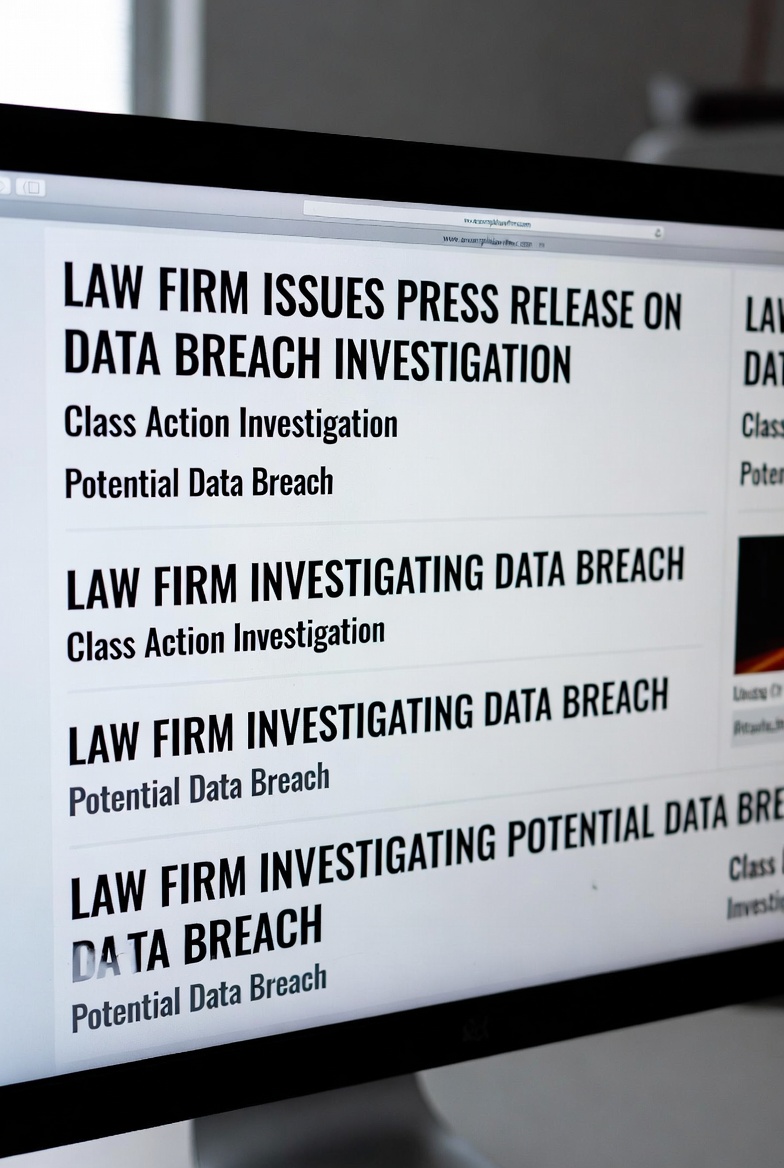
- A cottage industry of plaintiff class action firms monitors public breach disclosures, state attorney general filings, and breach notification databases, then rapidly issues press releases and search-optimized online solicitations offering to investigate claims on behalf of breach victims — often within hours of an announcement.
- Data breach class actions have been one of the fastest-growing areas in complex litigation for several years, with dozens of new suits filed every month across the country.
- Standing — the legal requirement that a plaintiff show a concrete injury — remains a serious and unresolved obstacle in many data breach cases. Courts in different federal circuits have reached different conclusions about what is sufficient.
- In most class action settlements, individual class members receive modest amounts — often a few dollars to a few hundred dollars. Attorneys' fees are subject to court approval and may be drawn from a common settlement fund or paid separately by the defendant; either way, they typically represent the largest single dollar amount in the settlement.
- Joining a class action does not prevent you from seeking independent legal advice about whether you have a stronger individual claim worth pursuing separately.
The breach notification letter arrives on a Tuesday. By Wednesday morning, a press release is circulating the wire services with the subject line "DATA BREACH ALERT" — followed by your company's name. A law firm you have never heard of announces it is "investigating claims" on behalf of affected individuals, directs anyone impacted to visit a website, and invites them to submit their information. By Thursday, a second firm has issued its own press release. A third follows on Friday. No lawsuit has been filed. No court has been involved. But the machinery is already running.
How the Solicitation Machine Works
The firms that operate in this space have developed sophisticated systems for identifying new breach opportunities as quickly as possible. They scrape breach notification databases, track filings with state attorneys general, and watch newswires for breach announcements. The goal is speed: file first, or at least solicit first, and be positioned when plaintiffs begin looking for representation.
The press releases these firms issue — typically distributed through PR Newswire or Globe Newswire — follow a recognizable formula. They name the breached company, describe the type of data compromised, announce that the firm is "investigating," and invite affected individuals to contact the firm or submit their information online. The releases are written to appear in search results when people search for information about the breach. They are effective. They generate large pools of potential class members quickly, which matters in class action practice: the breadth and composition of the class affects the damages model, and the overall size of the settlement fund is relevant to how courts evaluate fee petitions.
The Standing Problem They Don't Advertise
What these solicitation campaigns do not mention prominently is that many data breach class actions face a significant legal obstacle before they reach any meaningful stage: standing. Under federal law, a plaintiff must demonstrate a concrete, particularized injury to bring suit in federal court. In data breach cases, that requirement has proven surprisingly difficult to satisfy in many circumstances.
The U.S. Supreme Court's 2021 decision in TransUnion LLC v. Ramirez (No. 20-297) tightened standing requirements for class actions generally, holding that risk of future harm alone is not sufficient to establish the concrete injury needed for retrospective money damages. Lower courts applying TransUnion have frequently dismissed data breach cases where plaintiffs could not show that their stolen data had actually been misused — that identity theft, fraudulent charges, or other concrete harm had actually occurred. In October 2025, the U.S. Court of Appeals for the Fourth Circuit addressed the question in Holmes v. Elephant Insurance Co.: the court held that plaintiffs whose specific data had been confirmed as published on a dark web leak site had suffered a concrete injury sufficient for standing. At the same time, the court rejected the standing theories advanced by other plaintiffs in the same case who could not make that showing and were relying on the risk of future harm alone. That ruling binds courts within the Fourth Circuit (Maryland, Virginia, West Virginia, North Carolina, and South Carolina); other circuits have reached different conclusions on materially similar facts. The law on standing in data breach cases is genuinely unsettled and varies by jurisdiction.
This means many data breach cases face threshold dismissal fights over standing and injury. Some are dismissed at the pleading stage without any recovery for class members. When that happens, the soliciting firm moves on. The dismissed plaintiffs have consumed months waiting, signed away their information to a law firm, and sometimes executed retainer agreements that limit their options, all for a case that never survived the standing threshold.
"In data breach class actions, individual class members often receive a few dollars in a settlement — while the legal fees that made the case possible are calculated separately, in the hundreds of thousands or millions."
What Class Members Actually Recover
When data breach class actions do survive and settle — which many do, because the cost of defending through discovery frequently exceeds the cost of settlement — the outcomes for individual class members are often modest. In smaller breaches, class members have received gift cards, account credits, or cash payments of a few dollars. In larger, well-litigated cases involving confirmed misuse of data, class members have received more meaningful amounts, sometimes hundreds of dollars. Attorneys' fees are subject to court approval in every class action settlement and may be structured in one of two ways: in a common-fund settlement, fees are typically calculated as a percentage of the total fund and are drawn from it, reducing what remains for distribution to class members; in other structures, fees may be negotiated separately and paid by the defendant on top of class member payments. Either way, attorneys' fees commonly represent the largest single dollar amount in the settlement, and the structure is always disclosed in the settlement agreement filed with the court. Understanding which structure applies — and what it means for your individual recovery — is worth asking about before you participate.
That is not inherently improper. Class actions serve an important function: they allow many individuals who each suffered a small harm to aggregate their claims and hold defendants accountable in a way that no individual lawsuit could. Without plaintiffs' firms willing to take on the financial risk of these cases, many data breaches would never face any legal consequences at all. But it is worth understanding the economic structure before you respond to the next solicitation email.
The Solicitation Model and the Rules That Govern It
The press release and online solicitation model raises legitimate questions about attorney advertising rules — and the answers depend on the method of contact. Under the ABA Model Rules of Professional Conduct, Rule 7.3 draws a meaningful distinction between advertising directed at a general audience and direct solicitation targeted at a specific individual. Press releases distributed through newswires and websites designed to appear in search results generally constitute advertising, not direct solicitation. They are subject to disclosure requirements and prohibitions on false or misleading statements, but they are not subject to the stricter limits that apply when an attorney personally contacts a prospective client about a specific matter.
Direct, targeted solicitation — contacting you individually by phone, email, or text in response to a specific breach — is subject to more stringent rules. State bar rules vary, and many states have adopted their own versions of Rule 7.3 that differ from the ABA Model Rules in important respects. Generally speaking, direct personal contact with a prospective client who has not sought out the attorney is subject to limitations designed to prevent coercion, harassment, and overreaching. What is permissible depends on the jurisdiction and the specific method of contact.
The practical distinction is this: a general press release or search-optimized "investigation" website inviting the public to learn more is different in kind — and in regulatory treatment — from a firm that contacts you directly and personally with a targeted solicitation. If a law firm reaches out to you individually rather than through a general advertisement, it is worth understanding what triggered that contact and how they obtained your information before deciding how to respond.
What It Doesn't Change
None of this means that data breach victims lack legitimate claims or that class action litigation is without value. When a company stores sensitive personal data carelessly, suffers a preventable breach, and fails to notify affected individuals promptly, class action litigation is one of the tools available to provide some measure of accountability and compensation. The criticism here is not directed at the legal tool but at the solicitation methods that some firms use and the gap between what the press releases imply and what class members typically receive.
Individual circumstances vary significantly. A person whose Social Security number, medical records, and financial account data all appeared on a confirmed dark web leak site — with documented evidence of resulting identity theft — has a materially different legal position than a person who received a notification letter saying data "may have been accessed" with no evidence of misuse. The solicitation press release does not make that distinction. An attorney you consult individually will.
What This Means for You
If you received a breach notification and are being solicited by law firms: You are not required to respond to any press release or online solicitation. Doing so does not protect your rights and may actually limit them if you sign a retainer agreement without understanding its scope. If you believe you have a meaningful claim — particularly if you can document concrete harm like fraudulent charges, identity theft, or confirmed dark web exposure of your specific data — consult an attorney individually rather than simply joining a mass solicitation. Understand what you are signing before you sign it, including whether the retainer is exclusive, what the fee structure is, and what happens if the case is dismissed before settlement.
If you run a business that experienced a breach and are being named in solicitation press releases: The press releases are not lawsuits. A firm "investigating claims" has not filed anything and is not your adversary in any pending proceeding. That said, the volume of solicitations is an indicator of likely litigation, and early legal counsel is valuable — both for understanding your notification obligations and for preparing a defense if litigation does follow. The companies that respond best to post-breach litigation are typically the ones that responded well to the breach itself: promptly, transparently, and with documented care for affected individuals.
The law around data breach litigation is still being written, circuit by circuit, case by case. What is clear today is that the breach is only the beginning of the story. The notifications, the solicitations, the lawsuits, and the settlements are the chapters that follow. Knowing how each of them works — and who benefits from each — is the best preparation for navigating them.
This article is a summary prepared for general information and discussion purposes only. It does not constitute legal advice, is not a full analysis of the matters presented, and may not be relied upon as a substitute for competent legal counsel. Wright Law Firm, PLC provides no warranties, express or implied, regarding the accuracy or completeness of this information. Consult an attorney for advice specific to your situation.